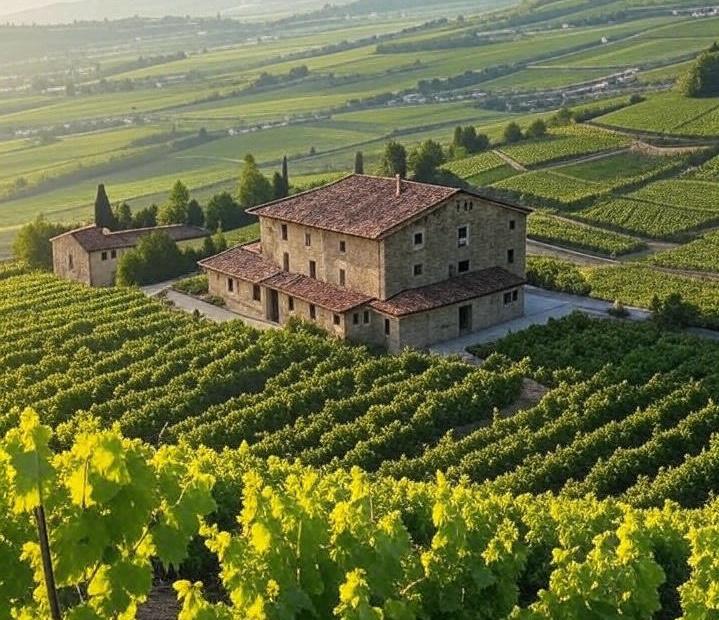
One of the two regions that are best known for producing blends at the highest quality is Rhône other being Bordeaux. It’s what I like to call the full symphony; like the multiple parcels and grapes, the tenor, strings, woodwinds, brass, percussions all play their part unified by the conductor who is the winemaker on the other hand there are also musicians with their single instrument displaying exceptional music, these for me are the Single vineyards.
While a blend ensures that there will be a great wine every year, blending allows winemakers to create more complex and harmonious wines by combining the strengths of different grapes and vineyard sites. They can blend same grapes from different sites, different grapes from the same site or different grapes from different sites.
A single vineyard wine shows the prowess and character of a single terroir changing every year. What’s the right way? Well, it’s what the winemaker wants to show.
The Northern Rhône blends are led by Syrah and blended with viognier to add aromatic opulence while Southern Rhône represents blending at larger capacities with the GSM style (Grenache Syrah Mourvedre) led by Grenache and the famed Chateauneuf du Pape that uses 13 grape varietals.
So, let’s explore some of the iconic Single Vineyard and Blended wines from the valleys for Rhône.
The Top Single Vineyard Wines
La La La by E. Guigal
These are not only at the top of Côte-Rôtie and Rhône, but they are at the echelon of red wines worldwide. The wines are not defined by the region, vice versa these wines defined the prowess of Côte-Rôtie.
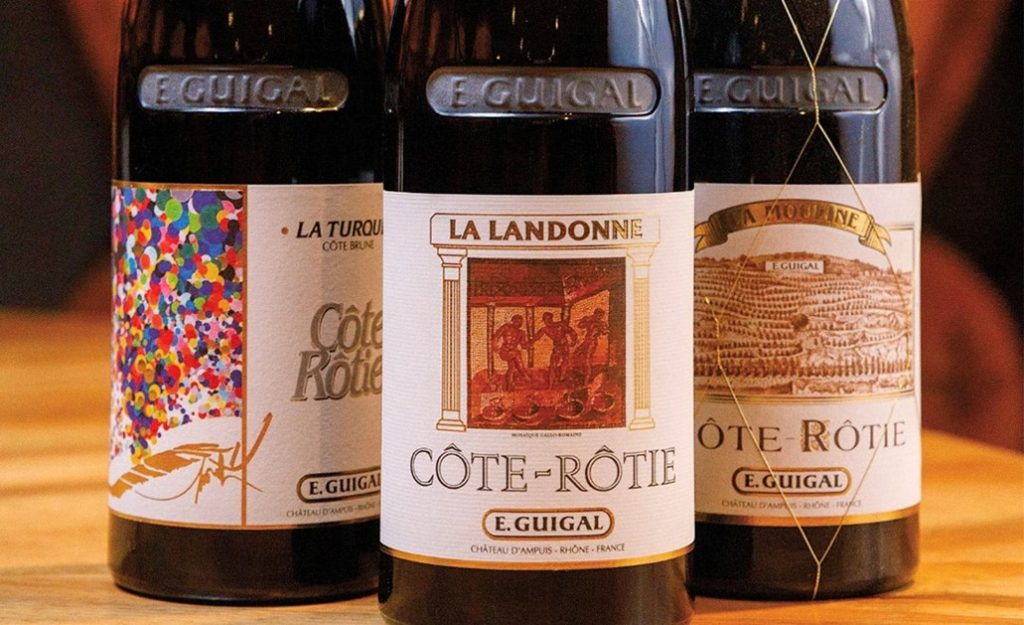
The Three La’s are La Mouline, La Landonne and La Turque; chronologically.
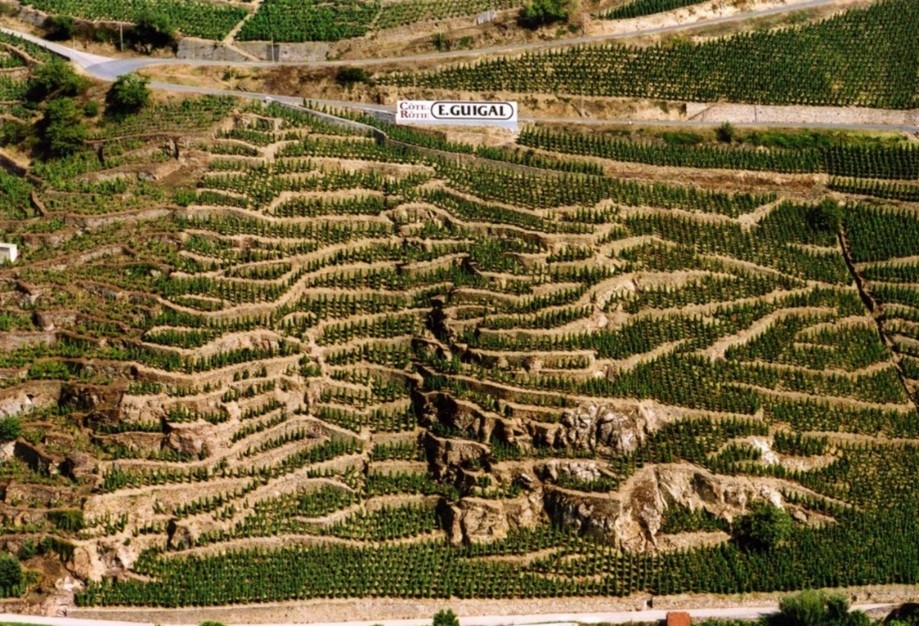
It was the first single vineyard Côte-Rôtie of E. Guigal. La Mouline is historically the oldest vineyard site in Cote-Rotie, with walls dating back 2,400. The vines are also the oldest in the region, averaging 90 years of age, with the oldest dating back to plantings in the 1890s.
Acquired in 1963 from the Dervieux family, it was .90 hectares that has grown to 1 hectare of the best parcel on Cote Blonde. The vines are planted to 89% Syrah and 11% Viognier. The Viognier gives the wine its famous aromatic complexity, they say it adds that feminine exotic character to the wine. La Mouline is usually the first of the three top wines from Guigal to be harvested. This is due to its specific, slightly warmer, precocious, microclimate. After fermentation and maceration for around 4 weeks it aged for 42 months in new oak barrels.
La Landonne
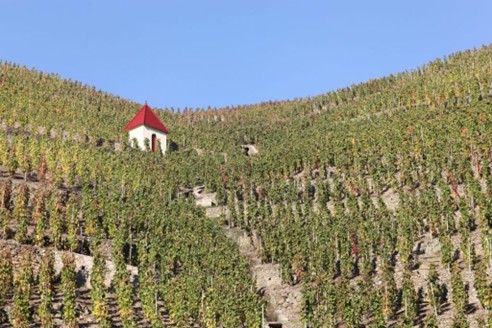
Guigal La Landonne debuted in 1978. The vines were planted in 1975 to celebrate the birth of Philippe Guigal. Today, the vines are on average 45 years of age. The vineyard is the northern most of Cote Brune, hence the last ripening vineyard. The 5.7-acre site is planted entirely with Syrah. It took the Guigals around a decade to acquire this vineyard, acquiring it from 17 small owner’s parcel by parcel and then replanted.
The parcel of vines used for Guigal La Landonne is planted to 100% Syrah on the Cote Brune which has a 45-degree gradient making it a tough job for harvesters. They start picking from the bottom of the vineyard and work their way to the top.
La Landonne is the statesman, a complete mirror to La Mouline. It is powerful and driven by its intensity and structure. The grapes are rarely destemmed to any degree. With fermentation and maceration, lasting 4 weeks. The wine is aged 42 months in new oak barrels.
La Turque
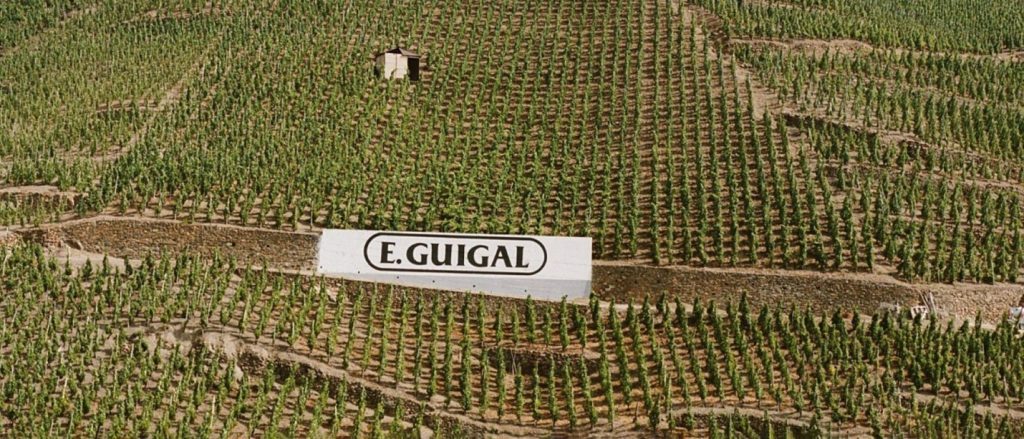
It was the last La to be added to the portfolio. The name La Turque has a long history in Cote Rotie. In fact, the original vineyard was known as La Turque until the mid-1930s. It was a piece of land known for producing great wines in the 19th and early 20th century but then it was not used for wine production for around 50 years.
Due to the depression and lack of interest in wine, the vineyard died out in 1935. Mr. Gachet, then owner, was broke and in debt to the government over taxes. Vines previously planted were allowed to go unattended during the 1930s, due to the difficulties in working the steep vineyards and in selling the wine.
It was the memory of those high-quality wines that Etienne Guigal had that they purchased the vineyard in 1980 and replanted it. The revered 1985 was the first vintage with only 200 cases produced.
Situated just north of the Côte Blonde and into the Côte Brune, La Turque is on a steep slope that enjoys perfect southern exposure. The vineyard is planted mostly with Syrah in addition to a small percentage of Viognier. The blend is generally 93% Syrah and 7% Viognier. Putting the style between Mouline and Landonne.
The Le Le Le by M. Chapoutier
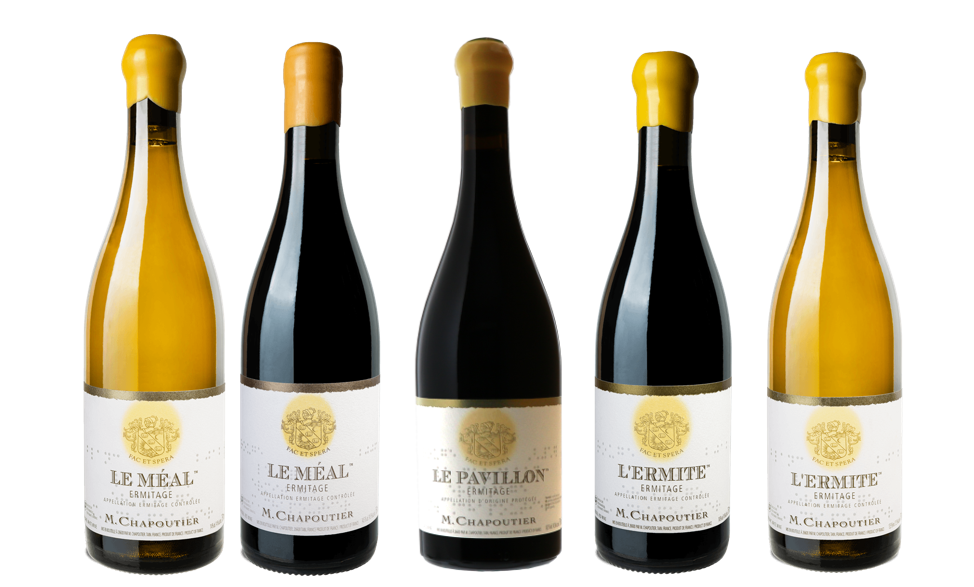
While Guilgal has the La’s, in Côte-Rôtie; M. Chapoutier has the Le’s in Hermitage. Undoubtedly, Chapoutier is the producer with the most concentration on producing world class Single vineyard expressions in Rhône Valley; with these three being the crème de la crème of their offerings.
Ermitage Rouge and Blanc ‘Le Méal’
A true superstar of Hermitage, Le Méal is regarded as one of the finest terroirs in the appellation, with its south-facing terraces of rolled pebbles and slopes with inclinations of up to 30%. Le Méal owes its official "lieu dit," to the old French word meaning "the best."

The rouge is 100% Syrah and is one of the most beautiful representations of the grape.
The blanc is 100% Marsanne. The vines (more than 50 years old) give low production and guarantee high quality. After pressing the entire grapes, the must is kept for cold settling between 24 and 48 hours. About 50% of the volume is vinified in big new wooden barrels (600 liters), the others ferment in vats for 10 to 12 months and exposed to lees stirring.
Ermitage Rouge ‘Le Pavillon’
Ermitage Rouge “Le Pavillon” Chapoutier is an icon of the Hermitage hill, in the Rhône. The age of the vines (90-100 years) guarantees very high-quality production. This plot has an area of approximately 4 ha
Grapes are hand-harvested to the limit of over-maturity. Due to their age, these vines give low yields. The grapes are totally destemmed, ferment in concrete tanks. Only the free-run wine is used for this single vineyard. The wine is matured in oak casks (with a 30% average proportion of new ones) between 18 and 20 months.
Ermitage Rouge and Blanc ‘Le Ermite’
The wine made its debut in 1996 The parcel is situated at the top of the Hermitage hill, around the chapel, in a place named the Ermite. The vines are 80 years old Syrah and are on granitic soils which are very poor. The blanc is 100% Marsanne selection of our oldest vines.
After a long period of fermentation. Free run juice is immediately transferred into new and one-year-old casks to be matured from 18 to 20 months. The rouge is matured on lees, with regular stirrings, between 10 and 12 months.
Domaine Jamet Cote Rotie Cote Brune
"Côte-Brune" is the only plot selection in the Domaine. A single vineyard wine that is produced from .5 hectares of old vine Syrah on the Cote Brune. 70% of those old vines were planted back in the 1940s. The remaining vines were planted in 1993. The wine made its debut with the 1976 vintage. Just 2,000 bottles a year are made of the Côte Brune.
Chateau Rayas Chateauneuf du Pape
The wine is pretty much the top 1% of wines that exist in entirety, Unmatchable singularity in the world of Chateauneuf-du-Pape where the game is of blending.
It was Jacques Reynaud who shot Rayas to its international fame. He was one of the true characters in Châteauneuf. A notoriously shy and private man, he was known to avoid appointments by hiding in ditches that lined the furrowed driveway leading to his château. It was rarely about classy aesthetic; it was always the wine.
Most of the things about Rayas are contrary to what Chateauneuf-du-Pape is about. A small 13-hectare vineyard nestled in one of the cooler climates of a warm sunlit region, in the heart of the woods, north facing, planted in very poor sandy soil none of the fabled "galets roulés", ridiculously low yields at around 15hl/h. Producing wines with great finesse using single variety used is Grenache.
The Top Blends
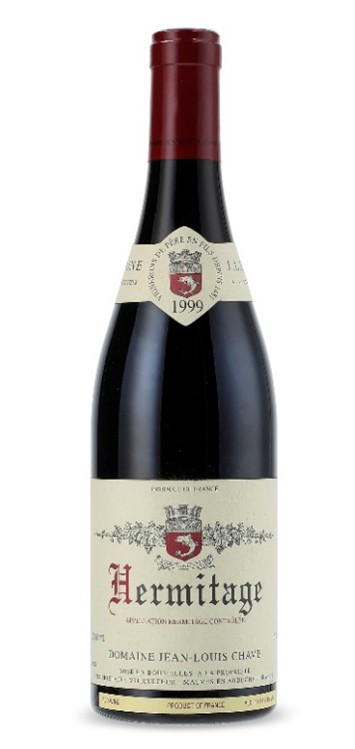
Domaine Jean-Louis Chave, Hermitage
One of the oldest and most respected wine families of Rhône, every bottle of Chave dons the date 1481, the year they started wine making. Sixteen generations and counting, it would be a real shame if this estate’s wines were not as unabashedly great as they are.
Chave owns 15 hectares of vines in Hermitage. 10 hectares are planted with Syrah and are used to produce two Hermitage Rouge wines, one being Chave Hermitage. Rest 5 hectares are planted with white varietals. The key to the beauty and complexity of Chave Hermitage comes from their mastery of blending.
While for the reds the only grape used is Syrah, it is sourced from 7 lieux-dits. The fruit from each vineyard is vinified separately. Each parcel is vinified and aged separately until the blending takes place. Vinified in combination of cement vats, stainless steel, and old, open, French oak barrels. The different wines are blended after 18 months in barrel. Jean Louis Chave waits for 60-90 days after blending before bottling.
Domaine Paul Jaboulet Aîné, La Chapelle, Hermitage
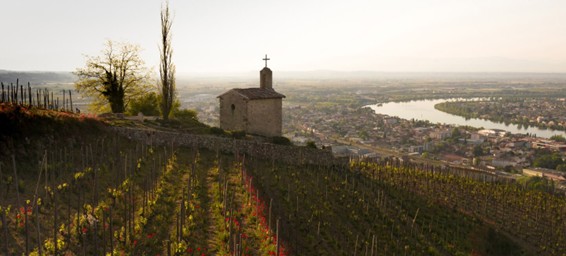
Named after the small stone chapel supposedly built as a retreat for a 13th-century knight who fell in love with this sun-baked hill high above the river Rhône. Produced mainly from the ancient vines in the granite soils of Le Méal and Les Bessards on the Hill of Hermitage. With vines from 40 to 100 years old, the famed balance and depth of La Chapelle is found in the final blend. Each terroir brings its aromatic characteristics and the elegance of the tannin structures which gives this wine an exceptional aging potential.
The wine was slowly going out limelight when the Frey family of Chateau La Lagune, Bordeaux revived it back to its glory.
Château de Beaucastel, Hommage à Jacques Perrin, Châteauneuf-du-Pape
Only produced in best vintages, the wine brilliantly embodies the Perrin Family credo: "A Great Wine is about emotion and civilization, a myth that endures beyond time. “First created in 1989 as a tribute to the late Jacques Perrin, only made in the very best years with old vine Mourvedre from their Courrieux vineyard. Production is extremely limited with only around 350 cases made at a time. 70% Mourvedre and 10% each of Grenache, Counoise and Syrah, all vinified in foudres.
The vineyard’s location in Chateauneuf is in the most northern sector of the appellation. This means that the north winds sweep down through the mountains and hit here first, which keeps the vineyards cool and stretches out the growing season. In terms of temperature Beaucastel ‘s northernly location keeps the vineyards cool, so there is always good acidity to the grapes, even in a hot year.
Henri Bonneau & Fils, Réserve des Célestins, Châteauneuf-du-Pape
Henri represents the 12th generation of his family to make wine in Châteauneuf du Pape, dating back to 1667, and his methods today continue to have more in common with the 17th century than with contemporary winemaking. Although he passed away in 2016, he left behind a substantial wine legacy.
The mythic Réserve des Célestins, are not only fantastically complex, and immense but are also gifted with that rare extra dimension found only in the greatest wines.
The estate ultimately covers only 6 hectares; his vines average 30 years, the age and produce around 25000 bottles of every vintage. From his first vintage of 1956, Bonneau has kept the production same; he doesn’t de-stem, gently crushes the whole clusters and then ferments for three weeks in concrete tanks with frequent pump-overs for gentle extraction. The estate produces mainly reds, mainly Grenache (between 75% and 85%), as well as Cinsault, Counoise and Mourdrève
Bonneau adds back his vin de presse for structure and then ages the wine in a random collection of neutral foudres, demi-muids and piéces, none of them younger than ten years old. Henri Bonneau's aging cellars are from the 17th century and are legendary. You can't find a barrel there less than 20 years old and most of them are very ancient.
Domaine Georges Vernay Condrieu Coteau de Vernon
One of the very reasons that one of my favorite grapes exist is Georges Vernay. In the 1950s, Georges realized that his beloved Viognier grape had been reduced to only about six hectares (for the world) and happily for all of us wine lovers, decided to take things in his own hands. Back then, a kilo of apricots cost more than did a kilo of Viognier grapes, and people in Condrieu were uprooting vineyards
This is one of his two famed cuvées coming from adjacent sites on the lofty Vernon slope, who’s unique arzelle topsoil of weathered granite and schist over clay which as per Georges is “the vine’s natural home.
50–80-year-old vines are planted in a 2.5 ha vineyard on south and south-east facing terraces. Mechanization is impossible on the very uneven and steep vineyard. The vines are cared for manually using organic farming techniques. Yields are very low at 25 hectoliters per hectare, and the fruit is picked at perfect ripeness to retain the terroir’s freshness and minerality. whole clusters for aromatic complexity, settles the juice and then ferments and ages her Condrieus in barrels, 25% new. The wine ages 12 to 18 months, with regular stirring of the lees, while the malolactic is blocked to preserve acidity.
Chateau Grillet
The Chateau Grillet appellation is a miniscule 3.5 hectares of vines. If you think 3.5 hectares is small, prior to 1971, only 1.7 hectares were under vine, making Chateau Grillet the smallest appellation in France at the time. The vineyard is planted to 100% Viognier with average age of 45 years.
100% Viognier planted on 87 marvelous terraces held by stone walls from the roman period. from each parcel are vinified on a parcel-by-parcel basis in small, steel tanks. Malolactic fermentations can take place in tank or either tanks or French oak barrels, depending on the needs of each parcel. The wine is then aged for an average of 20% new, French oak barrels for about 18 months.