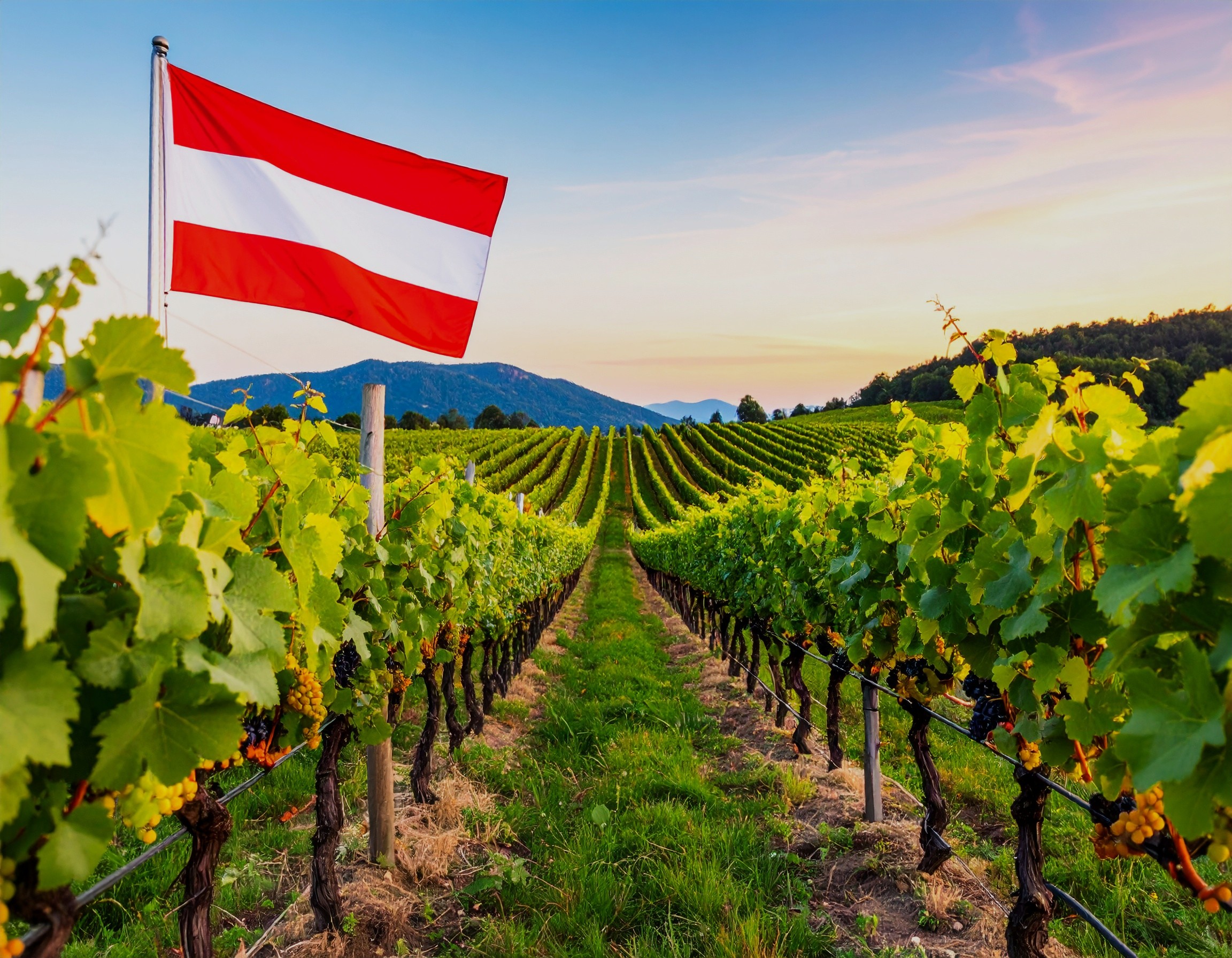
Austria may not be the first name that comes to mind when thinking about wine, but it absolutely deserves a place on your radar. This small country in Central Europe produces some of the world’s most elegant, balanced, and expressive wines. With a deep respect for tradition, a strong focus on quality, and increasing sustainability, Austria is a hidden gem in the wine world.
A Brief History of Austrian Wine
Austrian winemaking dates back to Roman times, especially after Emperor Probus lifted restrictions on viticulture in the provinces. The influence of Charlemagne and the Cistercian monks further refined vineyard practices. By the 13th century, Vienna was a major wine trading hub along the Danube.
Although Austrian wines were widely exported during the Renaissance, they didn’t quite gain the legendary status of Hungary’s Tokaji or Germany’s Riesling. Remarkably, Austria recorded its first Trockenbeerenauslese in 1526, centuries before Germany. However, wars and high taxes in the 17th century caused vineyard shrinkage.
The 20th century saw a return to high-volume production, aided by the Hochkultur vine training system. But a 1985 scandal involving diethylene glycol rocked the industry. This prompted Austria to implement some of the strictest wine laws in Europe and re-focus on quality.
Key Wine Regions
Austria’s vineyards are primarily located in the east. The country has four major winegrowing regions (Weinbaugebiete):
1. Niederösterreich (Lower Austria)
- Largest region with famous subzones like Wachau, Kamptal, and Kremstal.
- Wachau uses traditional classifications: Steinfeder (lightest), Federspiel, and Smaragd (richest).
- DAC system includes all eight subzones as of 2023.
2. Burgenland
- Known for top red and sweet wines.
- Blaufränkisch and Zweigelt dominate reds.
- Sweet specialties include Ausbruch from Rust and TBA wines from Neusiedlersee.
3. Steiermark (Styria)
- Mountainous region with three DACs: Südsteiermark, Weststeiermark, Vulkanland Steiermark.
- Focuses on Sauvignon Blanc, Welschriesling, and Schilcher rosés from Blauer Wildbacher.
4. Wien (Vienna)
- Only capital city with vineyards within city limits.
- Known for Gemischter Satz DAC, a field blend of at least three white varieties.
Grape Varieties
White Grapes:
- Grüner Veltliner: Austria’s flagship grape; peppery, fresh, and citrus-driven.
- Riesling: Elegant, high-acid wines often grown in terraced vineyards.
- Welschriesling, Chardonnay (Morillon), Weissburgunder, Sauvignon Blanc: Popular across various regions.
Red Grapes:
- Zweigelt: A 1922 crossing of Blaufränkisch x St. Laurent; Austria’s most planted red.
- Blaufränkisch: Spicy, structured reds.
- St. Laurent, Blauburger, Blauer Portugieser: Supportive roles in red wine production.
Wine Classification System
1. Wein:
- Basic category (formerly Tafelwein).
- May mention grape and vintage but only general origin: "Österreich."
2. Landwein:
- Regional wines from one of three large zones: Weinland, Steirerland, or Bergland.
3. Qualitätswein:
- Must pass tasting and lab tests.
- Shows origin, vintage, and grape(s); carries a red-white banderole.
Subcategories of Qualitätswein
Prädikatswein:
- Includes Spätlese, Auslese, Beerenauslese, Trockenbeerenauslese, Eiswein, Strohwein, and Ausbruch.
- Focused on sweetness; no chaptalization allowed.
Kabinett:
- A subset of Qualitätswein (not Prädikatswein).
- Dry/off-dry; no chaptalization or Süßreserve.
DAC (Districtus Austriae Controllatus):
- Indicates regional typicity.
- Only certain grapes/styles allowed.
- As of 2023, Austria has 18 DACs.
Austrian Sekt (Sparkling Wine)
In 2016, Austria introduced a new legal category for quality Sekt with Protected Designation of Origin. In 2022, three tiers were defined:
- Sekt Austria: Min. 9 months lees aging (6 months for tank method).
- Sekt Austria Reserve: Traditional method only, hand-harvested, 18 months lees.
- Sekt Austria Grosse Reserve: Grapes from a single village, 36 months lees, Brut style only.
Bottles carry a special red-white seal indicating origin and quality.
Labeling Terms
- Trocken: Dry
- Halbtrocken: Off-dry
- Reserve: Higher alcohol and aging (especially in DAC wines)
- Erste Lage / Ried: Top single-vineyard designations (not all legally protected)
In Conclusion
Austrian wine is a true blend of history, purity, and place. With strict laws, unique grapes, and high standards, it stands tall among Europe’s great wine nations. Whether you’re savoring a crisp Grüner or a rich Blaufränkisch, Austrian wine promises authenticity and depth.