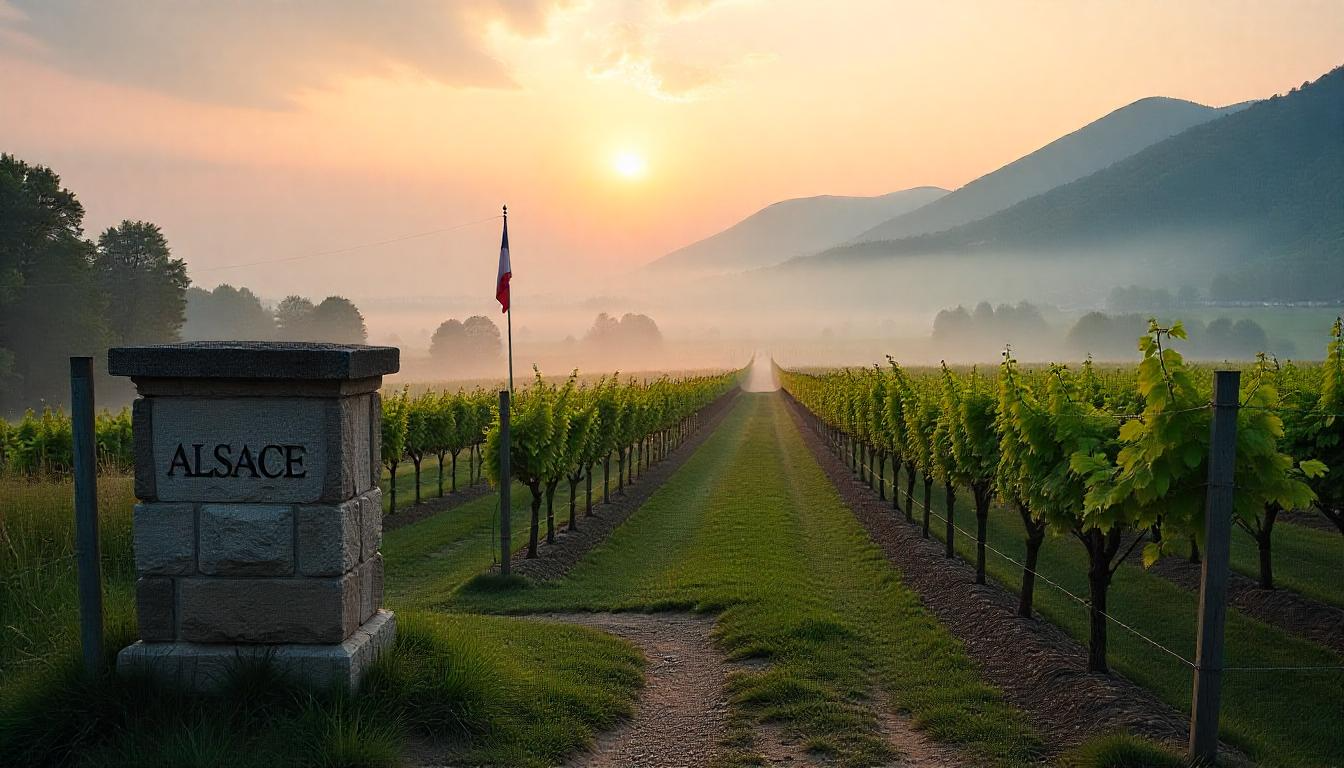
Alsace, nestled in the northeastern corner of France between the Vosges Mountains and the Rhine River, is a region where tradition, terroir, and typicity intersect beautifully. Though long admired for its aromatic whites and vibrant sparkling wines, Alsace still flies under the radar for many wine lovers. This blog aims to shed light on the complexities and charm of Alsace, from its geography and grape varieties to viticultural practices and stylistic signatures.
A Region at the Crossroads of Empires
Alsace’s story is as layered as its soil. For centuries, it was a political pawn between France and Germany. Once a part of the Holy Roman Empire, it came under French control after the Treaty of Westphalia in 1648. Later, Germany annexed it in 1871 after the Franco-Prussian War. Although Alsace briefly gained independence at the end of World War I, it was quickly reclaimed by France. After a Nazi occupation during World War II, it finally returned to French hands—permanently.
Today, Alsace, Lorraine, and Champagne together form France's Grand Est region, but Alsace remains distinctly Alsatian: culturally bilingual, gastronomically rich, and deeply rooted in its own wine traditions.
Geography & Climate
Alsace lies in a narrow ribbon of vineyard land between the Vosges Mountains to the west and the Rhine River to the east. The Vosges create a rain shadow effect, making Alsace one of the driest and sunniest regions in France—ideal conditions for viticulture. In fact, Colmar, in the heart of Alsace, is the driest city in the country.
This sunny, dry, and semi-continental climate allows for:
- Long, slow ripening seasons.
- Exceptionally aromatic grapes.
- Minimal disease pressure (encouraging organic/biodynamic farming).
The vineyards stretch along the lower eastern slopes of the Vosges, and site exposure is critical—south, southeast, and east-facing slopes capture precious sunlight, helping grapes ripen reliably despite the northern latitude.
A Geological Mosaic
Alsace is a patchwork of soils, unmatched in France for its complexity. Over 13 different soil types exist here, thanks to tectonic activity around the Rhine Rift. These include:
- Granite and volcanic soils on steeper slopes.
- Limestone and marl on the mid-slopes.
- Clay, gravel, and loess on the plains.
- Grès de Vosges, a distinctive local pink sandstone.
Each grape variety finds a natural match in certain soils. For example:
- Riesling thrives on granite and schist.
- Gewurztraminer loves clay-rich marl.
- Pinot Gris excels in volcanic soils.
Grape Varieties: Aromatic Excellence
Alsace is a white wine powerhouse—around 90% of its AOP production is white. While many grapes are grown, four “noble” varieties dominate the top-tier vineyards:
1. Riesling
- Dry, racy, and mineral.
- High in acidity and alcohol.
- Long-lived and food-friendly.
- Since 2008, AOP Riesling must be vinified dry.
2. Gewurztraminer
- Exotic and perfumed (lychee, rose, spice).
- Higher in alcohol and often off-dry.
- Low acidity but intensely aromatic.
3. Pinot Gris
- Formerly known as Tokay d’Alsace.
- Rich, smoky, and spicy.
- Full-bodied with moderate acidity.
- Signature grape of Alsace.
4. Muscat
- Made from Muscat Blanc à Petits Grains, Muscat Rosé, or Muscat Ottonel.
- Fragrant, grapey, and usually dry.
- Delicate with floral aromatics.
Other important grapes:
- Pinot Blanc (often blended with Auxerrois).
- Sylvaner, Chasselas, and Klevener de Heiligenstein (Savagnin Rose) from designated villages.
- Pinot Noir: the only red variety, used for still reds, rosé, and Crémant.
Appellations and Labeling
Alsace AOP (Vin d’Alsace AOP)
- Covers varietal and blended wines.
- Varietally labeled wines must contain 100% of that grape (except Pinot Blanc, which can include Auxerrois).
- If the label just says “Pinot,” it may include any combination of Pinot Noir, Gris, Blanc, or Auxerrois.
Edelzwicker
- A basic, non-vintage blend.
- No rules on grape composition.
Gentil
- A quality blend with at least 50% noble grapes.
- Base wines must be vinified separately.
Field Blends
- Made from co-planted varieties, fermented together.
- Advocated by producers like Marcel Deiss for terroir expression.
Alsace Grand Cru AOP
Alsace introduced its Grand Cru system in 1975, starting with Schlossberg. Today, there are 51 Grand Cru vineyards, each with its own AOP (as of 2011). These wines:
- Must be made from noble grapes (except Zotzenberg for Sylvaner and some blends in Altenberg de Bergheim and Kaefferkopf).
- Must be hand-harvested.
- Have lower yields and higher ripeness requirements.
- Have minimum potential alcohol of 11–12.5%, depending on grape.
New in 2024: Pinot Noir is now authorized in three Grand Crus—Hengst, Kirchberg de Barr, and Vorbourg—marking a significant evolution for red wines in Alsace.
Controversies persist due to the lack of a Premier Cru tier, the wide range in Grand Cru quality, and producers like Trimbach and Hugel choosing to market top wines without Grand Cru labeling.
Sweet Wines: Vendanges Tardives (VT) and Sélection de Grains Nobles (SGN)
Alsace produces some of France’s most elegant sweet wines, legally defined since 1984:
- Vendanges Tardives (VT):
- Made from late-harvested noble grapes.
- May or may not have botrytis.
- Emphasizes varietal character.
- Minimum ripeness: 244–270 g/L (depending on variety).
- Sélection de Grains Nobles (SGN):
- Made from botrytized berries.
- Concentrated and dessert-like.
- Suppresses varietal character in favor of botrytis complexity.
- Ripeness: up to 306 g/L—among France’s highest.
Sparkling Wines: Crémant d’Alsace AOP
Crémant d’Alsace is a traditional method sparkling wine, and the region is a major player in French sparkling wine after Champagne.
- Pinot Blanc and Auxerrois are the workhorse grapes.
- Chardonnay is allowed (nowhere else in still Alsace AOP).
- Riesling, Pinot Gris, and Pinot Noir also feature.
- Rosé Crémant is always 100% Pinot Noir.
Crémant now accounts for nearly 25% of Alsace’s production, offering excellent quality and value.
Conclusion: Alsace’s Unrivaled Diversity
Alsace is a region of precision, purity, and passion. Its wines are crystalline expressions of terroir—whether dry Rieslings from granite slopes, spicy Pinot Gris from volcanic soils, or sweet SGNs kissed by botrytis.
Though its political past has been tumultuous, today Alsace stands proudly as one of France’s most distinctive and rewarding wine regions. For wine lovers seeking aromatic whites, terroir expression, and stylistic variety, Alsace is simply unmissable.